Hinduism
Sasthamcotta Sree Dharma Sastha Temple
, India
About
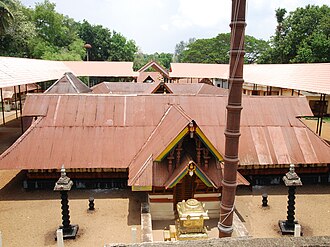
The Sasthamcotta Sree Dharma Sastha Temple rises beside the broad waters of Sasthamkotta Lake, the most expansive freshwater lake in Kerala, which embraces the temple precincts on three sides and lends the sanctuary a setting of rare stillness and natural sanctity.
The presiding deity is Shri Dharma Sastha, attended in this shrine by his consort Prabha and their son Sathyaka. As a manifestation that unites the streams of Vaishnava and Saiva devotion, Dharma Sastha is approached here in his benevolent householder aspect rather than the celibate forest form worshipped at neighbouring sites.
Sasthamcotta is counted among the five most ancient Sastha temples of Kerala, alongside Achankoil, Aryankavu, Kulathupuzha and Sabarimala. Together these sanctuaries map a sacred geography woven through the southern hills and lakes of the state, each shrine reflecting a distinct stage in the life of the deity.
The temple is also known throughout Kerala for the troops of monkeys who dwell within its precincts and are regarded as holy companions of the shrine. In 1996 a trust was established to ensure these animals continue to be fed when natural forage grows scarce, weaving compassion for living beings into the daily rhythm of worship.
History
Local tradition stretches the temple's spiritual lineage back to the Treta Yuga, narrating that Sri Rama, accompanied by Sita, Lakshmana and the vanara army, paused at Sasthamcotta on their return from Lanka to offer reverence to Shri Dharma Sastha. Rama is said to have performed pithru tharpan, ancestral rites, upon the banks of the lake whose waters are esteemed for their purity. Across the centuries the shrine has been sustained by local devotional patronage, and in modern times the surrounding lake was recognised as a Ramsar Wetland of International Importance, underscoring the unity of ecological and sacred care here.
Significance
As one of the five great Sastha kshetras of Kerala, Sasthamcotta forms an essential station on the regional pilgrimage to Lord Ayyappa's various forms. The shrine's link to Sasthamkotta Lake and its protected troop of monkeys make it a place where the worship of Dharma is felt as continuous with the protection of land, water and creature.
Visiting
Engage with Sasthamcotta Sree Dharma Sastha Temple
Through the four pathways
Seva सेवा — Service
Offer your time and skills here. The following opportunities are open at Sasthamcotta Sree Dharma Sastha Temple:
No Seva offerings listed yet.
Sādhana साधना — Practice
Learn the worship and practice associated with Sasthamcotta Sree Dharma Sastha Temple:
No Sādhana offerings listed yet.
Sandhāna सन्धान — Wisdom
Unite with the wisdom of this tradition:
No Sandhāna offerings listed yet.
Sādhya साध्य — Giving
Support this sacred place according to your means:
No Sādhya offerings listed yet.
All giving flows directly to Sasthamcotta Sree Dharma Sastha Temple. Mandala does not take a commission.
Related sacred places
.JPG%2F1280px-A_a_b_c_d_e_(13).JPG&w=3840&q=75) Hinduism
HinduismAmarnath Temple
, India
A high Himalayan cave shrine in Jammu and Kashmir where a naturally forming ice lingam is venerated as Lord Śiva, drawing one of India's great seasonal pilgrimages.
temple
 Hinduism
Badami cave temples
, India
A celebrated complex of sixth- to eighth-century Hindu, Jain, and (likely) Buddhist cave temples carved into the red sandstone cliffs of Badami in northern Karnataka, India.
temple
 Hinduism
Badrinath Temple
, India
A major Himalayan Vaiṣṇava pilgrimage temple in Uttarakhand, India — one of the four Char Dham and one of the 108 Divya Desams sacred to the worship of Lord Vishnu.
temple
 Hinduism
BAPS Shri Swaminarayan Mandir London
, United Kingdom
A traditional Swaminarayan Hindu mandir in Neasden, north-west London — celebrated as the first authentically built Hindu stone temple in Britain and in Europe.
temple
 Hinduism
Besakih
, Indonesia
Bali's principal Hindu sanctuary — the 'Mother Temple' (Pura Besakih) — set high on the slopes of the sacred volcano Gunung Agung in eastern Bali, Indonesia.
temple
 Hinduism
Bhimashankar Temple
, India
A revered Śiva temple in the forested Sahyadri hills of Maharashtra, India, enshrining one of the twelve Jyotirliṅgas and standing close to the source of the Bhīmā River.
temple