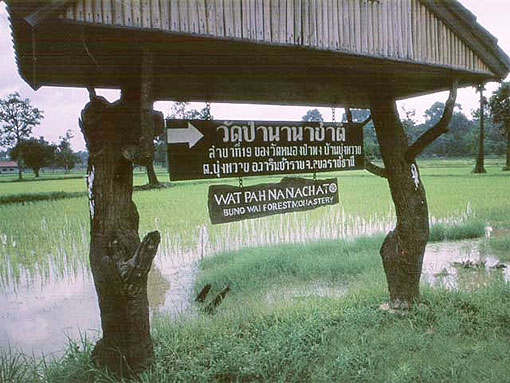
Annatanama · Public domain
Buddhism
Wat Pah Nanachat
, Thailand
About
Wat Pah Nanachat — 'International Forest Monastery' — lies in the forests of northeast Thailand, roughly fifteen kilometres outside Ubon Ratchathani. The monastery was established in 1975 by the renowned forest master Ajahn Chah as a training ground for monastics from outside Thailand, conducted within the disciplines of the Thai Forest Tradition.
Resident monks, novices, and postulants gather here from many nations, and the working language of the community is English. The first abbot was Ajahn Sumedho, an American bhikkhu trained under Ajahn Chah at Wat Nong Pah Pong — the motherhouse from which Wat Pah Nanachat descends. From this small forest seed an international family of branch monasteries has taken root under the collective name of the Forest Sangha.
Daily life follows the rhythms set by Ajahn Chah's lineage: a 3am rising, predawn chanting and meditation in the main sala, the alms round at sunrise, a single morning meal, work practice, Dhamma reflections, and evening communal practice. Both anapanasati and the cultivation of samatha and vipassana as inseparable aspects of practice are honoured, while strict observance of the Vinaya remains the defining feature of monastic life.
Lay guests dress modestly in white, observe the eight precepts, and join the community in every part of the daily schedule.
History
The monastery emerged in response to a wave of interest from the West — particularly from the United Kingdom — in the Thai forest Theravada tradition. Ajahn Chah founded the new community in 1975 to allow non-Thais to train in his lineage without the language barrier they faced at the Thai-speaking Wat Nong Pah Pong.
Ajahn Sumedho served as its first abbot from 1975 to 1977 before leaving to establish branch monasteries in Britain, eventually founding Amaravati near London. He was succeeded by Ajahn Pabhakaro, Ajahn Jagaro, Ajahn Pasanno, Ajahn Jayasaro, Ajahn Nyanadhammo, and from 2007 onward by Ajahn Kevali, who has fostered a more communal monastic life.
Visiting
Engage with Wat Pah Nanachat
Through the four pathways
Seva सेवा — Service
Offer your time and skills here. The following opportunities are open at Wat Pah Nanachat:
No Seva offerings listed yet.
Sādhana साधना — Practice
Learn the worship and practice associated with Wat Pah Nanachat:
No Sādhana offerings listed yet.
Sandhāna सन्धान — Wisdom
Unite with the wisdom of this tradition:
No Sandhāna offerings listed yet.
Sādhya साध्य — Giving
Support this sacred place according to your means:
No Sādhya offerings listed yet.
All giving flows directly to Wat Pah Nanachat. Mandala does not take a commission.
Gallery
Annatanama · Public domain
Related sacred places
 Buddhism
Pagoda of Chengtian Temple
, People's Republic of China
An eleven-storeyed brick pagoda in Yinchuan, Ningxia, China, built on the site of a Western Xia Buddhist temple and standing as the tallest pagoda in the region.
monastery
 Buddhism
Pagoda of Cishou Temple
, People's Republic of China
A sixteenth-century stone and brick Chinese pagoda in the Buddhist Cishou Temple at Balizhuang, Haidian District, Beijing, originally named the Yong'an Wanshou Pagoda.
monastery
 Buddhism
Songyue Pagoda
, People's Republic of China
The oldest surviving brick pagoda in China, built in 523 CE on Mount Song in Henan and inscribed on the UNESCO World Heritage List as part of the Historic Monuments of Dengfeng.
monastery
 Buddhism
Wanbu Huayanjing Pagoda
, People's Republic of China
The eleventh-century Liao-era White Pagoda of Hohhot in Inner Mongolia, an octagonal seven-storey brick tower built to enshrine ten thousand copies of the Avatamsaka Sutra.
monastery
_%25E0%25B8%25A7%25E0%25B8%25B1%25E0%25B8%2594%25E0%25B8%25AD%25E0%25B8%25A3%25E0%25B8%25B1%25E0%25B8%258D%25E0%25B8%258D%25E0%25B8%25B4%25E0%25B8%2581_%25E0%25B8%259E%25E0%25B8%25B4%25E0%25B8%25A9%25E0%25B8%2593%25E0%25B8%25B8%25E0%25B9%2582%25E0%25B8%25A5%25E0%25B8%2581_-_IMG_01.jpg%2F1280px-Wat_Aranyik_Phitsanulok_(March_2022)_%25E0%25B8%25A7%25E0%25B8%25B1%25E0%25B8%2594%25E0%25B8%25AD%25E0%25B8%25A3%25E0%25B8%25B1%25E0%25B8%258D%25E0%25B8%258D%25E0%25B8%25B4%25E0%25B8%2581_%25E0%25B8%259E%25E0%25B8%25B4%25E0%25B8%25A9%25E0%25B8%2593%25E0%25B8%25B8%25E0%25B9%2582%25E0%25B8%25A5%25E0%25B8%2581_-_IMG_01.jpg&w=3840&q=75) Buddhism
BuddhismWat Aranyik
, Thailand
A historic Theravada Buddhist temple in Phitsanulok, northern Thailand, whose name evokes the ancient forest-dwelling tradition of Thai monastic practice.
monastery
_%25E0%25B8%25A7%25E0%25B8%25B1%25E0%25B8%2594%25E0%25B9%2580%25E0%25B8%259A%25E0%25B8%258D%25E0%25B8%2588%25E0%25B8%25A1%25E0%25B8%259A%25E0%25B8%259E%25E0%25B8%25B4%25E0%25B8%2595%25E0%25B8%25A3%25E0%25B8%2594%25E0%25B8%25B8%25E0%25B8%25AA%25E0%25B8%25B4%25E0%25B8%2595%25E0%25B8%25A7%25E0%25B8%2599%25E0%25B8%25B2%25E0%25B8%25A3%25E0%25B8%25B2%25E0%25B8%25A1%25E0%25B8%25A3%25E0%25B8%25B2%25E0%25B8%258A%25E0%25B8%25A7%25E0%25B8%25A3%25E0%25B8%25A7%25E0%25B8%25B4%25E0%25B8%25AB%25E0%25B8%25B2%25E0%25B8%25A3_%25E0%25B9%2580%25E0%25B8%2582%25E0%25B8%2595%25E0%25B8%2594%25E0%25B8%25B8%25E0%25B8%25AA%25E0%25B8%25B4%25E0%25B8%2595_%25E0%25B8%2581%25E0%25B8%25A3%25E0%25B8%25B8%25E0%25B8%2587%25E0%25B9%2580%25E0%25B8%2597%25E0%25B8%259E%25E0%25B8%25A1%25E0%25B8%25AB%25E0%25B8%25B2%25E0%25B8%2599%25E0%25B8%2584%25E0%25B8%25A3_(3).jpg%2F1280px-thumbnail.jpg&w=3840&q=75) Buddhism
BuddhismWat Benchamabophit
, Thailand
A royal Buddhist wat in Bangkok's Dusit District, beloved as the Marble Temple for its gleaming Italian-stone façade and refined late-nineteenth-century craftsmanship.
monastery