.jpg%2F1280px-Bayezid_I_Mosque_-_Y%25C4%25B1ld%25C4%25B1r%25C4%25B1m_Camii_(1).jpg&w=3840&q=75)
Islam
Bayezid I Mosque
, Turkey
About
The Bayezid I Mosque — known in Turkish as the Yıldırım Camii or Yıldırım Bayezid Camii — stands on a low hill in the Yıldırım district of Bursa, the early Ottoman capital. It was built between 1391 and 1395 as part of a large religious-charitable complex (külliye) endowed by Sultan Bayezid I, called Yıldırım (the Thunderbolt) for the speed of his campaigns.
Both the mosque and the surrounding district carry the sultan's epithet to this day. The building suffered severely in the great Bursa earthquake of 1855 and was extensively restored in its aftermath.
In plan the mosque follows the inverted-T (zaviye) type favoured in early Ottoman Bursa. A large central hall under a great dome is flanked east and west by lower eyvāns under smaller domes, with a third domed eyvān containing the miḥrāb to the south. Four side rooms with fireplaces and storage niches lie to the north and south of these eyvāns. The northern semi-open prayer porch is divided into five domed bays. Two minarets rise at the sides.
The Yıldırım Camii is also a milestone in Ottoman architecture: it is the first building to use the so-called 'Bursa arch' — a flattened arch between the central hall and the southern eyvān that links and supports the two principal domes. Unusually for its time in Bursa, the mosque is built entirely of dimension stone, with no brick used in its fabric.
Visiting
Engage with Bayezid I Mosque
Through the four pathways
Seva सेवा — Service
Offer your time and skills here. The following opportunities are open at Bayezid I Mosque:
No Seva offerings listed yet.
Sādhana साधना — Practice
Learn the worship and practice associated with Bayezid I Mosque:
No Sādhana offerings listed yet.
Sandhāna सन्धान — Wisdom
Unite with the wisdom of this tradition:
No Sandhāna offerings listed yet.
Sādhya साध्य — Giving
Support this sacred place according to your means:
No Sādhya offerings listed yet.
All giving flows directly to Bayezid I Mosque. Mandala does not take a commission.
Related sacred places
 Islam
IslamAbu'l-Fida Mosque
, Syria
A medieval Sunni mosque and mausoleum complex on the banks of the Orontes River in Hama, Syria, where Ayyubid and Mamluk craftsmanship meet within a single walled sacred precinct.
mosque
_(14593689400).jpg%2F1280px-By_Nile_and_Tigris_-_a_narrative_of_Journeys_in_Egypt_and_Mesopotamia_on_behalf_of_the_British_Museum_between_the_years_1886_and_1913_(1920)_(14593689400).jpg&w=3840&q=75) Islam
IslamAl-Kadhimiya Mosque
, Iraq
One of the foremost Twelver Shia shrines, set in the Kāẓimiya district of Baghdad, Iraq, sheltering the tombs of the seventh and ninth Imams as well as great Shia scholars of the medieval era.
mosque
 Islam
IslamAl-Quds Mosque Hamburg
, Germany
A former Sunni Muslim mosque in the German port city of Hamburg, which served local worshippers from 1993 until its closure was ordered by German security authorities in 2010.
mosque
 Islam
IslamBasharat Mosque
, Spain
The principal Ahmadiyya mosque of Spain, built at Pedro Abad near Córdoba and inaugurated in 1982 as the centre of the Ahmadiyya community in the country.
mosque
 Islam
IslamBerlin Mosque
, Germany
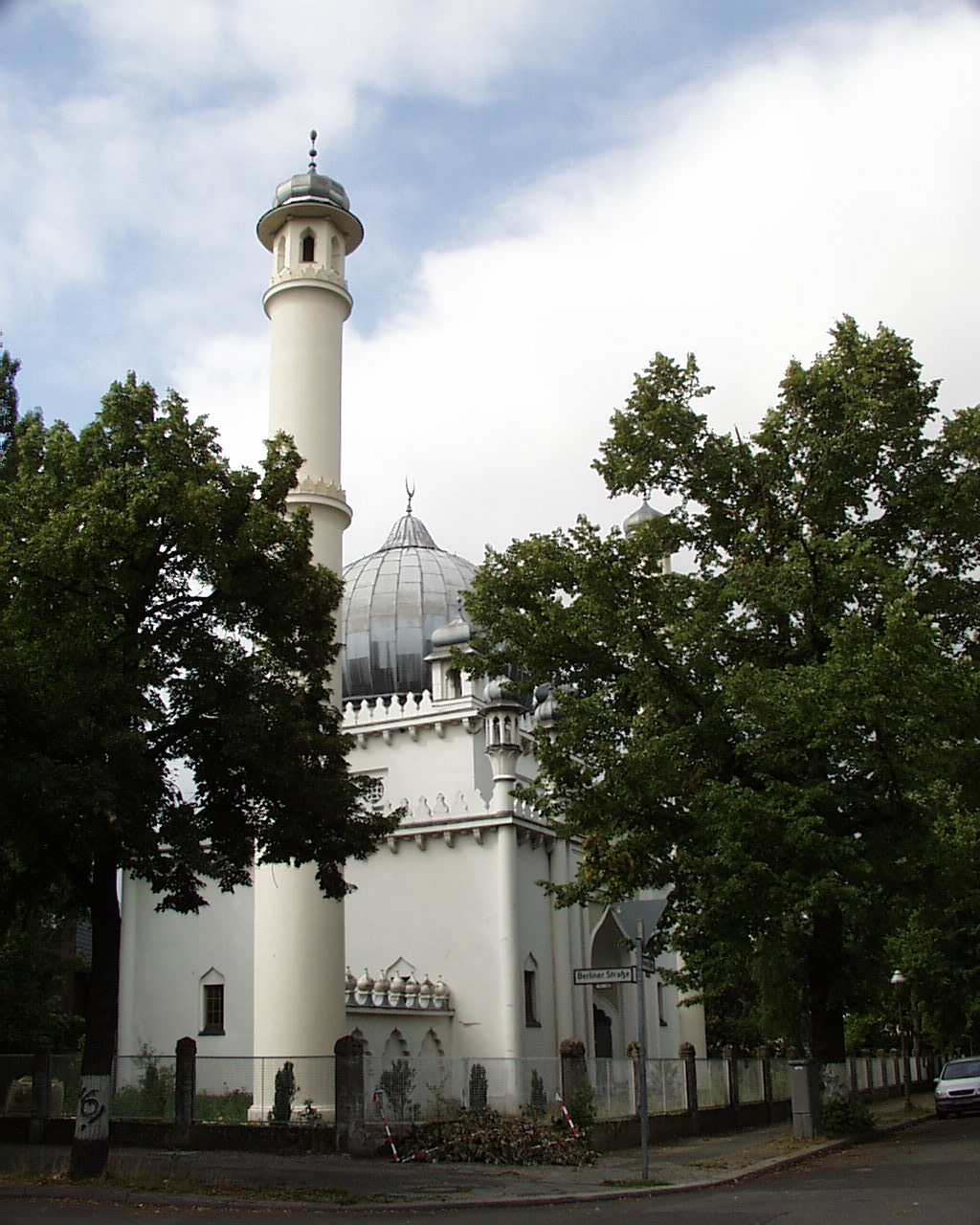
The oldest surviving mosque in Germany, built in Berlin's Wilmersdorf district in the 1920s in a Neo-Mughal style and administered by the Lahore Ahmadiyya Movement.
mosque
 Islam
IslamBlue Mosque
, Afghanistan
The Blue Mosque of Mazar-i-Sharif — the Shrine of Hazrat Ali — a turquoise-tiled mosque and mausoleum revered across Afghanistan as one of the holiest sites in the country.
mosque