Axel Mauruszat · Attribution
Islam
Berlin Mosque
, Germany
About
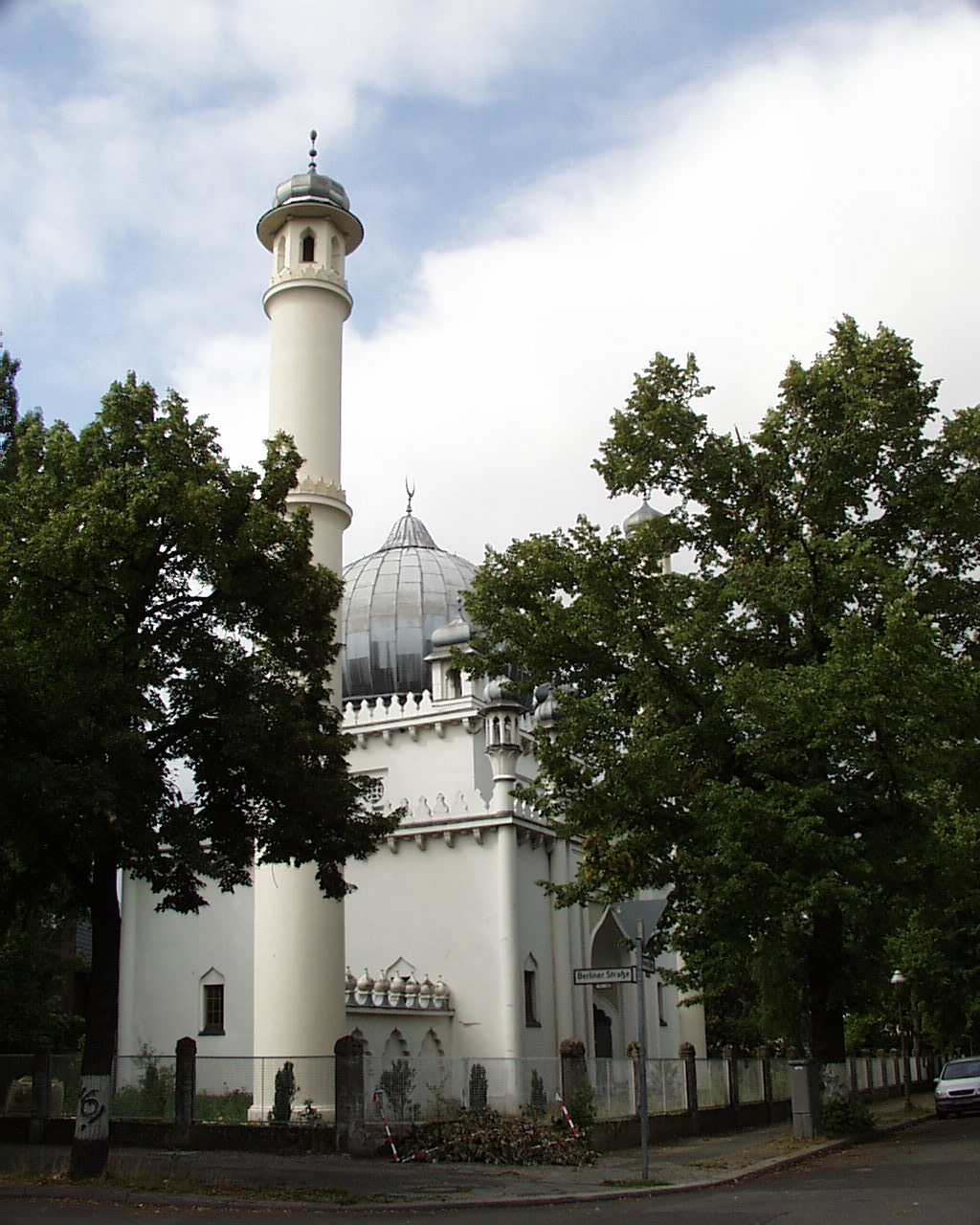
Standing at Brienner Straße 7–8 in the Wilmersdorf borough of the German capital, the Berlin Mosque — officially the Wilmersdorfer Moschee — was designed by the architect K. A. Hermann and built between 1923 and 1925. The Lahore Ahmadiyya Movement (Ahmadiyya Anjuman Ishāʿat-i-Islām Lahore) owns and manages the mosque.
On 6 August 1923 the foundation stone was set in place, and on 26 April 1925 the completed mosque was officially inaugurated. Hermann shaped the mosque in a Neo-Mughal idiom — onion dome, pastel surfaces, and a symmetrical front recalling the tombs of the Mughal Empire and most famously the Taj Mahal. Two slim minarets, each 27 metres (90 feet) high, rise on either side of the prayer hall, and a two-storey imam's residence stands beside the mosque.
The minarets and dome were heavily damaged by Soviet shelling during the Second World War. The mosque was reopened in 1952 after a grant from the Berlin Monuments Department made initial repairs possible, and the two minarets themselves were finally rebuilt between 1999 and 2001.
History
The mosque grew out of the early-1920s effort of the Indian Muslim activists known as the Kheri Brothers — Abdul Jabbar and Abdus Sattar Kheri — to establish an Islamic centre in Berlin. Their initial conversations with the German Muslim Dr Khalid Banning led, through correspondence with the Shah Jehan Mosque at Woking in England, to the involvement of the Lahore Ahmadiyya Movement, which agreed to take on the project. Construction began in 1923 and was completed in 1925. Earlier modest Muslim prayer structures had existed near Berlin, but they did not survive; the Wilmersdorf mosque is the oldest mosque still standing in Germany.
Significance
As the longest-standing mosque in the country, the Berlin Mosque is a key landmark in the history of Islam in Germany and in early twentieth-century European Islam more broadly. Its Neo-Mughal architecture also stands as an early example of South Asian Muslim sacred design transplanted to the heart of Europe.
Visiting
Engage with Berlin Mosque
Through the four pathways
Seva सेवा — Service
Offer your time and skills here. The following opportunities are open at Berlin Mosque:
No Seva offerings listed yet.
Sādhana साधना — Practice
Learn the worship and practice associated with Berlin Mosque:
No Sādhana offerings listed yet.
Sandhāna सन्धान — Wisdom
Unite with the wisdom of this tradition:
No Sandhāna offerings listed yet.
Sādhya साध्य — Giving
Support this sacred place according to your means:
No Sādhya offerings listed yet.
All giving flows directly to Berlin Mosque. Mandala does not take a commission.
Gallery
Axel Mauruszat · Attribution
Axel Mauruszat · Attribution
Related sacred places
 Islam
IslamAbu'l-Fida Mosque
, Syria
A medieval Sunni mosque and mausoleum complex on the banks of the Orontes River in Hama, Syria, where Ayyubid and Mamluk craftsmanship meet within a single walled sacred precinct.
mosque
_(14593689400).jpg%2F1280px-By_Nile_and_Tigris_-_a_narrative_of_Journeys_in_Egypt_and_Mesopotamia_on_behalf_of_the_British_Museum_between_the_years_1886_and_1913_(1920)_(14593689400).jpg&w=3840&q=75) Islam
IslamAl-Kadhimiya Mosque
, Iraq
One of the foremost Twelver Shia shrines, set in the Kāẓimiya district of Baghdad, Iraq, sheltering the tombs of the seventh and ninth Imams as well as great Shia scholars of the medieval era.
mosque
 Islam
IslamAl-Quds Mosque Hamburg
, Germany
A former Sunni Muslim mosque in the German port city of Hamburg, which served local worshippers from 1993 until its closure was ordered by German security authorities in 2010.
mosque
 Islam
IslamBasharat Mosque
, Spain
The principal Ahmadiyya mosque of Spain, built at Pedro Abad near Córdoba and inaugurated in 1982 as the centre of the Ahmadiyya community in the country.
mosque
.jpg%2F1280px-Bayezid_I_Mosque_-_Y%25C4%25B1ld%25C4%25B1r%25C4%25B1m_Camii_(1).jpg&w=3840&q=75) Islam
IslamBayezid I Mosque
, Turkey
An early Ottoman congregational mosque in Bursa, Turkey, raised between 1391 and 1395 as the centrepiece of the great külliye complex of Sultan Bayezid I, called 'Yıldırım' — the Thunderbolt.
mosque
 Islam
IslamBlue Mosque
, Afghanistan
The Blue Mosque of Mazar-i-Sharif — the Shrine of Hazrat Ali — a turquoise-tiled mosque and mausoleum revered across Afghanistan as one of the holiest sites in the country.
mosque