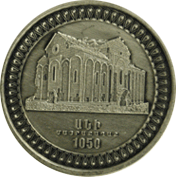
Central Bank of Armenia · Public domain
Christianity
Cathedral of Ani
, Turkey
About
The Cathedral of Ani (Armenian: Անիի մայր տաճար) is the largest surviving structure of the ruined medieval city of Ani, the capital of Bagratid Armenia, on the present-day Turkish-Armenian border. Begun in 989 and completed in the early eleventh century, it served for almost fifty years as the throne of the Catholicos — supreme primate of the Armenian Apostolic Church.
It was designed by the great Armenian architect Trdat, who is also remembered as the master called in to rebuild the collapsed dome of Hagia Sophia in Constantinople in the 990s. The cathedral takes the form of a domed basilica laid out on a rectangular plan, although the dome and the greater part of its drum no longer stand.
Its use of pointed arches and clustered piers has long fascinated scholars of architectural history, who often note how strikingly its forms anticipate — and perhaps directly influenced — the Gothic style that would later flower in western Europe.
After the Seljuk conquest of Ani in 1064, the building was turned into a mosque; in later centuries it returned to use as an Armenian church before the city itself was gradually abandoned. The conical dome collapsed in the earthquake of 1319, and the north-western corner suffered further heavy damage in the 1988 earthquake. The whole site of Ani — cathedral, churches, palaces, and city walls — was inscribed as a UNESCO World Heritage Site in 2016.
History
After more than two centuries of Arab rule, Armenia regained independence under the Bagratuni dynasty around 885; in 961 King Ashot III made Ani his capital, and the city grew to perhaps 100,000 inhabitants. Construction of the cathedral began in 989 under King Smbat II, with the architect Trdat in charge. The work was interrupted when Smbat died later that year, and Trdat travelled to Constantinople to repair the collapsed dome of Hagia Sophia. He returned in 993, and the cathedral was completed under Queen Katramide, wife of King Gagik I, by 1001 (or 1010 — the inscription on the northern wall has been read both ways). A silver cross once topped the conical dome, and a crystal chandelier brought by Smbat II from India hung within. In the 1010s, under Catholicos Sargis I, a mausoleum honouring the Hripsimean virgins was added beside the cathedral.
Significance
The Cathedral of Ani is one of the defining monuments of Armenian Christian architecture and a cornerstone of the Armenian Apostolic Church's medieval heritage. Its pointed arches and clustered piers have made it a recurring touchstone in debates over the origins of the Gothic style.
Visiting
Engage with Cathedral of Ani
Through the four pathways
Seva सेवा — Service
Offer your time and skills here. The following opportunities are open at Cathedral of Ani:
No Seva offerings listed yet.
Sādhana साधना — Practice
Learn the worship and practice associated with Cathedral of Ani:
No Sādhana offerings listed yet.
Sandhāna सन्धान — Wisdom
Unite with the wisdom of this tradition:
No Sandhāna offerings listed yet.
Sādhya साध्य — Giving
Support this sacred place according to your means:
No Sādhya offerings listed yet.
All giving flows directly to Cathedral of Ani. Mandala does not take a commission.
Gallery
Central Bank of Armenia · Public domain
Peshdimaldjian · Public domain
Related sacred places
 Christianity
Albenga Cathedral
, Italy
A medieval Roman Catholic cathedral in Liguria, Italy, dedicated to Saint Michael the Archangel and serving as seat of the Diocese of Albenga-Imperia.
church
 Christianity
Alexander Nevsky Cathedral
, Bulgaria
The Bulgarian Orthodox cathedral of Saint Alexander Nevsky in Sofia, a vast neo-Byzantine landmark and one of the largest Eastern Orthodox church buildings in the world.
church
 Christianity
Altamura Cathedral
, Italy
A thirteenth-century Roman Catholic cathedral in Apulia, southern Italy, dedicated to the Assumption of the Blessed Virgin Mary and a Hohenstaufen 'palatine' church.
church
_(5964742991).jpg%2F1280px-An_Auxiliary_Building_at_Bolnisi_Sioni_(I)_(5964742991).jpg&w=3840&q=75) Christianity
ChristianityBolnisi Sioni
, Georgia
A late-fifth-century Georgian Orthodox basilica in Bolnisi — the oldest surviving church building in Georgia, famed for its early Georgian-script inscriptions.
church
 Christianity
Cathedral Basilica of St. Mary
, Romania
A Roman Catholic cathedral basilica dedicated to the Blessed Virgin Mary — a name shared by several historic cathedral churches in Latin America and Europe.
church
 Christianity
Cathedral of Christ the Saviour
, Bosnia and Herzegovina
Moscow's great Russian Orthodox cathedral on the bank of the Moskva River — built, demolished under Soviet rule, and raised again in the 1990s as a memorial of national gratitude.
church