
Christianity
Cathedral of Christ the Saviour
, Bosnia and Herzegovina
About
The Cathedral of Christ the Saviour (Храм Христа Спасителя) stands on the northern bank of the Moskva River, only a few hundred metres south-west of the Kremlin. At 103 metres in overall height, it is the third tallest Eastern Orthodox church building in the world.
The present cathedral is the second to occupy the site. The first was raised in the nineteenth century in fulfilment of Tsar Alexander I's manifesto of 25 December 1812 — a thanksgiving for Russia's preservation against Napoleon and a memorial to the fallen. After early plans by Aleksandr Vitberg were abandoned, Tsar Nicholas I commissioned Konstantin Thon to design a Russian Revival church inspired by Hagia Sophia. Built over decades, it was consecrated on 26 May 1883, the day before the coronation of Alexander III; Russian masters including Kramskoi, Surikov, and Vereshchagin painted its interiors.
In 1931 the original cathedral was demolished by order of the Soviet Politburo to make way for a planned Palace of the Soviets, a colossal seat for the Supreme Soviet begun in 1937 but halted in 1941 by the German invasion; its steel frame was dismantled a year later, and the palace was never built.
After the dissolution of the Soviet Union, the cathedral was rebuilt on its original site between 1995 and 2000, recovering both the silhouette and the memorial purpose of the nineteenth-century church.
History
The original cathedral was raised in fulfilment of Alexander I's 1812 manifesto, which called for a church 'to signify Our gratitude to Divine Providence for saving Russia' from Napoleon's invasion. Thon's Russian Revival design was approved in 1832; the cornerstone was laid on a new site near the Kremlin in 1839. Scaffolding came down in 1860, and ongoing interior work continued for another two decades. The cathedral was consecrated in 1883. It was demolished by the Soviet government in 1931, and was rebuilt — closely following Thon's original — between 1995 and 2000.
Visiting
Engage with Cathedral of Christ the Saviour
Through the four pathways
Seva सेवा — Service
Offer your time and skills here. The following opportunities are open at Cathedral of Christ the Saviour:
No Seva offerings listed yet.
Sādhana साधना — Practice
Learn the worship and practice associated with Cathedral of Christ the Saviour:
No Sādhana offerings listed yet.
Sandhāna सन्धान — Wisdom
Unite with the wisdom of this tradition:
No Sandhāna offerings listed yet.
Sādhya साध्य — Giving
Support this sacred place according to your means:
No Sādhya offerings listed yet.
All giving flows directly to Cathedral of Christ the Saviour. Mandala does not take a commission.
Related sacred places
 Christianity
Albenga Cathedral
, Italy
A medieval Roman Catholic cathedral in Liguria, Italy, dedicated to Saint Michael the Archangel and serving as seat of the Diocese of Albenga-Imperia.
church
 Christianity
Alexander Nevsky Cathedral
, Bulgaria
The Bulgarian Orthodox cathedral of Saint Alexander Nevsky in Sofia, a vast neo-Byzantine landmark and one of the largest Eastern Orthodox church buildings in the world.
church
 Christianity
Altamura Cathedral
, Italy
A thirteenth-century Roman Catholic cathedral in Apulia, southern Italy, dedicated to the Assumption of the Blessed Virgin Mary and a Hohenstaufen 'palatine' church.
church
_(5964742991).jpg%2F1280px-An_Auxiliary_Building_at_Bolnisi_Sioni_(I)_(5964742991).jpg&w=3840&q=75) Christianity
ChristianityBolnisi Sioni
, Georgia
A late-fifth-century Georgian Orthodox basilica in Bolnisi — the oldest surviving church building in Georgia, famed for its early Georgian-script inscriptions.
church
 Christianity
Cathedral Basilica of St. Mary
, Romania
A Roman Catholic cathedral basilica dedicated to the Blessed Virgin Mary — a name shared by several historic cathedral churches in Latin America and Europe.
church
 Christianity
Cathedral of Ani
, Turkey
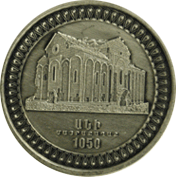
The eleventh-century Armenian Apostolic cathedral of the ruined Bagratid capital of Ani in eastern Turkey — the largest standing building of that lost medieval city.
church