
Christianity
Church of the Holy Sepulchre
, Q12950813
About
Known both as the Church of the Holy Sepulchre and as the Church of the Resurrection (Anastasis), this fourth-century basilica stands within Jerusalem's Old City, in its Christian Quarter. For Christians of nearly every tradition it is the holiest place on earth, drawing pilgrims continuously since its earliest dedication.
Within its walls Christian tradition locates both Calvary (Golgotha), the rock on which Jesus was crucified, and the rock-cut tomb in which he was laid and from which he is said to have risen on the third day. The tomb itself is now enclosed by a nineteenth-century shrine known as the Aedicule. The last four Stations of the Via Dolorosa likewise lie within the church.
The original basilica and rotunda were built under Emperor Constantine the Great in the fourth century, destroyed in 1009 under the Fatimid caliph al-Hakim, and rebuilt by 1048 under Emperor Constantine IX Monomachos. After the Crusader capture of Jerusalem in 1099, further work gave the church much of its present form.
The church is simultaneously the seat of the Greek Orthodox, Armenian Apostolic, and Latin Catholic Patriarchates of Jerusalem. Custody is shared among the Greek Orthodox, Latin Catholic, Armenian Apostolic, Coptic, Syriac, and Ethiopian Orthodox communities under the 1757 Status Quo, which has governed every door, lamp, and ledge of the church in essentially unchanged form for more than two and a half centuries.
History
After the Roman destruction of Jerusalem in AD 70 and the building of Aelia Capitolina under Emperor Hadrian, the site of the tomb is said to have been buried beneath the foundations of a pagan temple. Following his vision of the Cross in 312 and the legalisation of Christianity, Constantine the Great consented to the request of Bishop Macarius of Jerusalem to clear the site; the first Constantinian church was raised in the fourth century. After its destruction in 1009 the church was rebuilt by 1048 and then much altered in the Crusader and later periods. The Aedicule enclosing the tomb dates in its present form to the nineteenth century. Adjacent to the church, the Lutheran Church of the Redeemer marks a Protestant presence at the wider site.
Significance
For most of the world's Christians, the Church of the Holy Sepulchre is the holiest place of Christian faith — the meeting point of the Crucifixion and the Resurrection — and the touchstone of Christian pilgrimage from the fourth century to the present. Its shared custody also stands as a remarkable, if not always easy, witness to the diversity of the Christian tradition.
Visiting
Engage with Church of the Holy Sepulchre
Through the four pathways
Seva सेवा — Service
Offer your time and skills here. The following opportunities are open at Church of the Holy Sepulchre:
No Seva offerings listed yet.
Sādhana साधना — Practice
Learn the worship and practice associated with Church of the Holy Sepulchre:
No Sādhana offerings listed yet.
Sandhāna सन्धान — Wisdom
Unite with the wisdom of this tradition:
No Sandhāna offerings listed yet.
Sādhya साध्य — Giving
Support this sacred place according to your means:
No Sādhya offerings listed yet.
All giving flows directly to Church of the Holy Sepulchre. Mandala does not take a commission.
Gallery
GPT Image 2; prompted by Meow · Public domain
Related sacred places
 Christianity
Albenga Cathedral
, Italy
A medieval Roman Catholic cathedral in Liguria, Italy, dedicated to Saint Michael the Archangel and serving as seat of the Diocese of Albenga-Imperia.
church
 Christianity
Alexander Nevsky Cathedral
, Bulgaria
The Bulgarian Orthodox cathedral of Saint Alexander Nevsky in Sofia, a vast neo-Byzantine landmark and one of the largest Eastern Orthodox church buildings in the world.
church
 Christianity
Altamura Cathedral
, Italy
A thirteenth-century Roman Catholic cathedral in Apulia, southern Italy, dedicated to the Assumption of the Blessed Virgin Mary and a Hohenstaufen 'palatine' church.
church
_(5964742991).jpg%2F1280px-An_Auxiliary_Building_at_Bolnisi_Sioni_(I)_(5964742991).jpg&w=3840&q=75) Christianity
ChristianityBolnisi Sioni
, Georgia
A late-fifth-century Georgian Orthodox basilica in Bolnisi — the oldest surviving church building in Georgia, famed for its early Georgian-script inscriptions.
church
 Christianity
Cathedral Basilica of St. Mary
, Romania
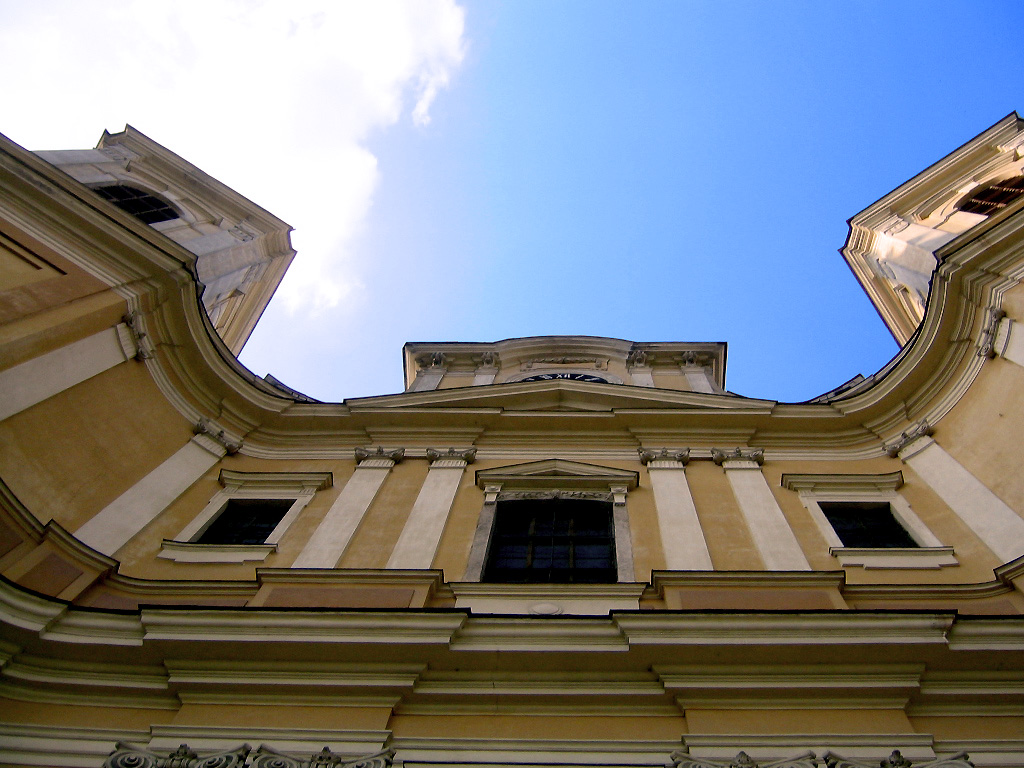
A Roman Catholic cathedral basilica dedicated to the Blessed Virgin Mary — a name shared by several historic cathedral churches in Latin America and Europe.
church
 Christianity
Cathedral of Ani
, Turkey
The eleventh-century Armenian Apostolic cathedral of the ruined Bagratid capital of Ani in eastern Turkey — the largest standing building of that lost medieval city.
church