
Islam
Hassan II Mosque
, Morocco
About
Standing on a promontory between the harbour of Casablanca and the El Hank lighthouse, the Hassan II Mosque was conceived to honour both the faith of the Moroccan people and the country's living traditions of sacred craftsmanship. Its main hall and outer courts can together hold one hundred and five thousand worshippers for the Friday and festival prayers.
The vast prayer hall accommodates twenty-five thousand within, with another eighty thousand on the surrounding esplanade. A 210-metre minaret, sixty storeys high, rises above the complex, its summit bearing a green laser beam directed towards the Kaaba in Mecca to remind those at prayer of the qibla. The retractable roof opens to the sky and the sea air, and the marble walls and zellij tilework are the work of Moroccan maalems gathered from across the kingdom.
A founding inspiration of the mosque is the verse of the Quran reminding the faithful that God's throne is upon the water, which moved King Hassan II to build the prayer hall partly over the ocean itself. Worshippers may pray with the Atlantic visible beyond the colonnades.
The complex also includes a madrasa, hammams, a museum of Moroccan craft and history, conference halls, and one of the most comprehensive Islamic libraries. Forty-one ornamented fountains punctuate the courtyards, and the surrounding gardens are tended as a setting for community life.
History
After the death of King Mohammed V in 1961, his son Hassan II first sought a mausoleum that would honour his father with the country's finest craftsmanship. That mausoleum was ultimately raised in Rabat, but the impulse to commission a great religious monument remained.
In 1980, the king declared his intention to build a mosque on the shore of Casablanca, where the faithful might contemplate both sky and ocean as they remembered the Creator. Designed by Michel Pinseau and built by Bouygues with thousands of Moroccan artisans, construction began on 12 July 1986. The mosque was inaugurated on 30 August 1993, the 11th of Rabi al-Awwal 1414 AH.
The mosque was largely financed by public subscription: twelve million Moroccans contributed, with even the smallest gifts acknowledged.
Significance
The Hassan II Mosque is the most prominent Sunni mosque in Morocco and a focal point of national religious life along the Atlantic coast. Its scale, its meeting of sea and sky, and the participation of millions of ordinary Moroccans in its construction give it a place in modern Islamic memory beyond its architecture alone.
Visiting
Engage with Hassan II Mosque
Through the four pathways
Seva सेवा — Service
Offer your time and skills here. The following opportunities are open at Hassan II Mosque:
No Seva offerings listed yet.
Sādhana साधना — Practice
Learn the worship and practice associated with Hassan II Mosque:
No Sādhana offerings listed yet.
Sandhāna सन्धान — Wisdom
Unite with the wisdom of this tradition:
No Sandhāna offerings listed yet.
Sādhya साध्य — Giving
Support this sacred place according to your means:
No Sādhya offerings listed yet.
All giving flows directly to Hassan II Mosque. Mandala does not take a commission.
Related sacred places
 Islam
IslamAbu'l-Fida Mosque
, Syria
A medieval Sunni mosque and mausoleum complex on the banks of the Orontes River in Hama, Syria, where Ayyubid and Mamluk craftsmanship meet within a single walled sacred precinct.
mosque
_(14593689400).jpg%2F1280px-By_Nile_and_Tigris_-_a_narrative_of_Journeys_in_Egypt_and_Mesopotamia_on_behalf_of_the_British_Museum_between_the_years_1886_and_1913_(1920)_(14593689400).jpg&w=3840&q=75) Islam
IslamAl-Kadhimiya Mosque
, Iraq
One of the foremost Twelver Shia shrines, set in the Kāẓimiya district of Baghdad, Iraq, sheltering the tombs of the seventh and ninth Imams as well as great Shia scholars of the medieval era.
mosque
 Islam
IslamAl-Quds Mosque Hamburg
, Germany
A former Sunni Muslim mosque in the German port city of Hamburg, which served local worshippers from 1993 until its closure was ordered by German security authorities in 2010.
mosque
 Islam
IslamBasharat Mosque
, Spain
The principal Ahmadiyya mosque of Spain, built at Pedro Abad near Córdoba and inaugurated in 1982 as the centre of the Ahmadiyya community in the country.
mosque
.jpg%2F1280px-Bayezid_I_Mosque_-_Y%25C4%25B1ld%25C4%25B1r%25C4%25B1m_Camii_(1).jpg&w=3840&q=75) Islam
IslamBayezid I Mosque
, Turkey
An early Ottoman congregational mosque in Bursa, Turkey, raised between 1391 and 1395 as the centrepiece of the great külliye complex of Sultan Bayezid I, called 'Yıldırım' — the Thunderbolt.
mosque
 Islam
IslamBerlin Mosque
, Germany
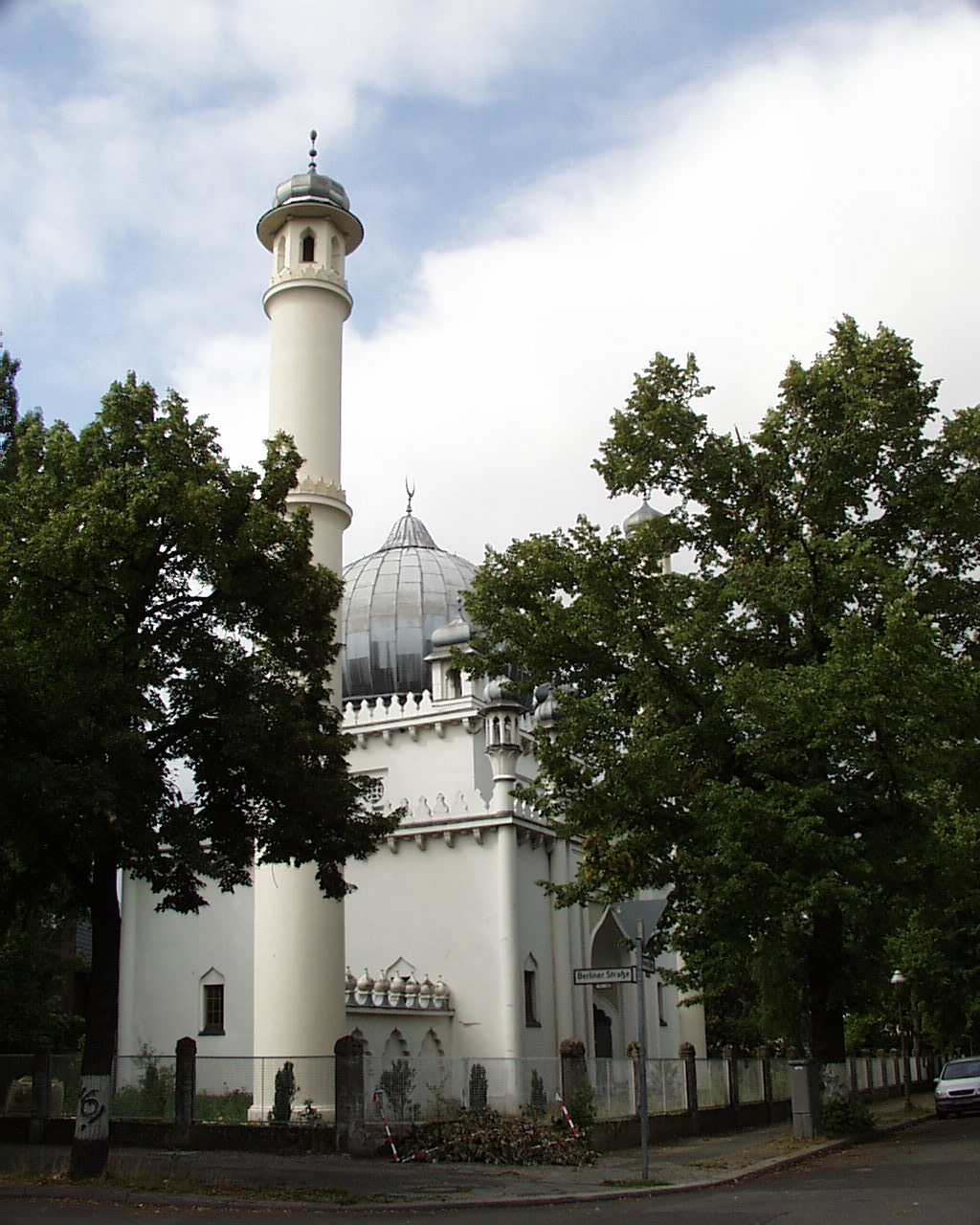
The oldest surviving mosque in Germany, built in Berlin's Wilmersdorf district in the 1920s in a Neo-Mughal style and administered by the Lahore Ahmadiyya Movement.
mosque