
Christianity
Innsbruck Cathedral
, Austria
About
The cathedral stands at the heart of the Tyrolean capital, an eighteenth-century Baroque sanctuary raised on the site of a twelfth-century Romanesque parish church. Designed by Johann Jakob Herkomer, it was built between 1717 and 1724 and is widely regarded as one of the most important Baroque buildings in the Tyrol.
Three domed vaults span the nave and a fourth dome with lantern rises above the chancel. The interior is among the great expressions of southern German Baroque, with ceiling frescoes by Cosmas Damian Asam depicting scenes from the life of Saint James and stucco decoration by his brother Egid Quirin Asam.
The cathedral guards two treasures dear to the devotion of the Tyrol. Above the high altar hangs the Maria Hilf, the Mother of Succour, painted by Lucas Cranach the Elder around 1530 and venerated as one of the most beloved Marian icons in central Europe. In the north aisle stands the canopied 1620 tomb of Archduke Maximilian III of Austria, who served as Grand Master of the Teutonic Order.
The building was heavily damaged in the Second World War but was fully restored within a few years, and continues to serve as the cathedral church of Innsbruck, the spiritual centre of a diocese erected in 1968.
History
The first reference to a church on the site dates to 1180, when the establishment of a market on the right bank of the Inn led to the founding of the old town of Innsbruck. The early Romanesque church was rebuilt and enlarged several times across the medieval centuries, damaged by fire and earthquake, and shown by Albrecht Durer in a 1495 watercolour as a single-spired church behind fortified walls.
The church became an independent parish in 1643, freed from the long oversight of Wilten Abbey. In 1650 Archduke Ferdinand Charles donated the Cranach Maria Hilf to the church, where it has since been venerated. After repeated earthquake damage, the citizens petitioned for a new building; Herkomer's design was chosen in 1716 and the cathedral dedicated on 9 September 1724 by Kaspar Ignaz Count Kunigl, Prince-Bishop of Brixen.
Visiting
Engage with Innsbruck Cathedral
Through the four pathways
Seva सेवा — Service
Offer your time and skills here. The following opportunities are open at Innsbruck Cathedral:
No Seva offerings listed yet.
Sādhana साधना — Practice
Learn the worship and practice associated with Innsbruck Cathedral:
No Sādhana offerings listed yet.
Sandhāna सन्धान — Wisdom
Unite with the wisdom of this tradition:
No Sandhāna offerings listed yet.
Sādhya साध्य — Giving
Support this sacred place according to your means:
No Sādhya offerings listed yet.
All giving flows directly to Innsbruck Cathedral. Mandala does not take a commission.
Gallery
Related sacred places
 Christianity
Albenga Cathedral
, Italy
A medieval Roman Catholic cathedral in Liguria, Italy, dedicated to Saint Michael the Archangel and serving as seat of the Diocese of Albenga-Imperia.
church
 Christianity
Alexander Nevsky Cathedral
, Bulgaria
The Bulgarian Orthodox cathedral of Saint Alexander Nevsky in Sofia, a vast neo-Byzantine landmark and one of the largest Eastern Orthodox church buildings in the world.
church
 Christianity
Altamura Cathedral
, Italy
A thirteenth-century Roman Catholic cathedral in Apulia, southern Italy, dedicated to the Assumption of the Blessed Virgin Mary and a Hohenstaufen 'palatine' church.
church
_(5964742991).jpg%2F1280px-An_Auxiliary_Building_at_Bolnisi_Sioni_(I)_(5964742991).jpg&w=3840&q=75) Christianity
ChristianityBolnisi Sioni
, Georgia
A late-fifth-century Georgian Orthodox basilica in Bolnisi — the oldest surviving church building in Georgia, famed for its early Georgian-script inscriptions.
church
 Christianity
Cathedral Basilica of St. Mary
, Romania
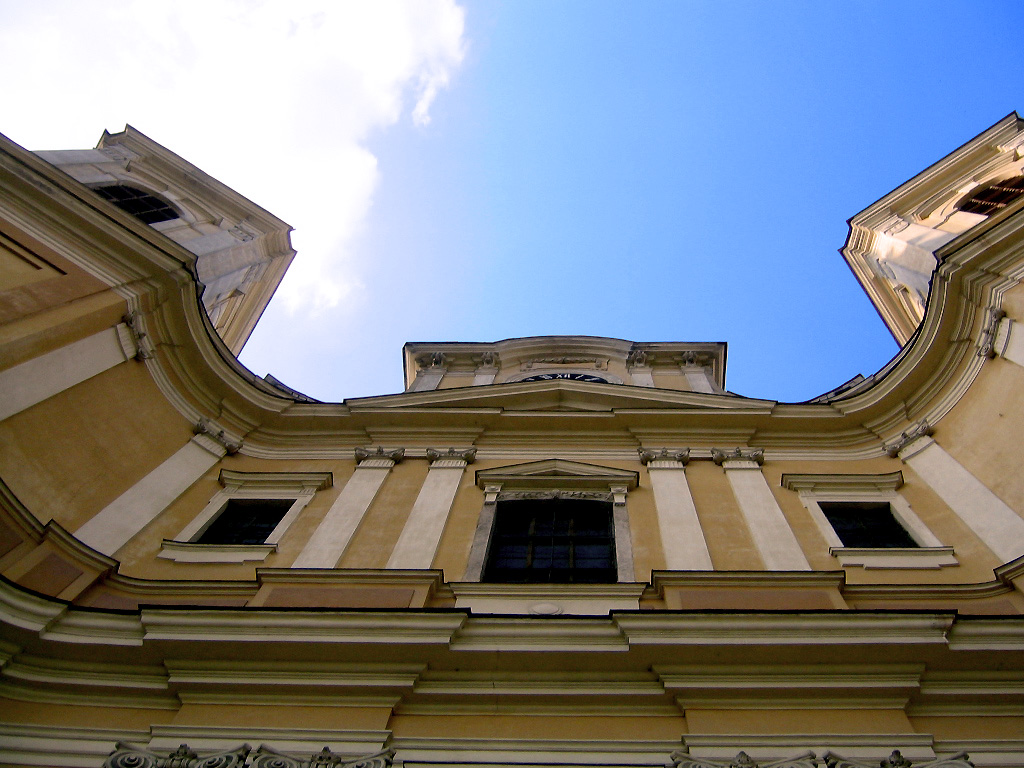
A Roman Catholic cathedral basilica dedicated to the Blessed Virgin Mary — a name shared by several historic cathedral churches in Latin America and Europe.
church
 Christianity
Cathedral of Ani
, Turkey
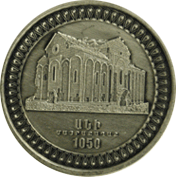
The eleventh-century Armenian Apostolic cathedral of the ruined Bagratid capital of Ani in eastern Turkey — the largest standing building of that lost medieval city.
church