
Christianity
St. Gallen Cathedral
, Switzerland
About
The Stiftskirche St. Gallus und Otmar, the Collegiate Church of Saints Gall and Otmar, rises in the historic centre of St. Gallen in northeastern Switzerland. Once the principal church of the Abbey of St. Gall, the building has served since 1847 as the cathedral of the diocese and is regarded as one of the last great Baroque sanctuaries of Europe.
According to long tradition, the wandering Irish monk Saint Gall built his hermitage upon this spot in 612 and was buried there around 650. His disciples remained beside the cell, following the rule of Saint Columban, until Saint Otmar enlarged the small hermitage into the great Abbey of St. Gall in 719.
The present cathedral was begun in 1755 under Prince-abbot Cölestin Gugger von Staudach and completed in 1767, designed by Peter Thumb of the Auer Zunft, who also planned the celebrated Abbey Library nearby. Within, frescoes by Josef Wannenmacher cover the vaults, and Switzerland's most complete set of historic church bells hangs in the twin towers, including a small bell said to have been carried from Ireland by Saint Gall himself.
The abbey was dissolved by the canton in 1805, after which the church served as a parish before being elevated to a cathedral in 1847. A careful interior restoration between 1962 and 1967 returned the sanctuary to its original Baroque appearance, and the entire complex was inscribed on the UNESCO World Heritage List.
History
Saint Gall's hermitage gave rise after his death to a community that grew through the seventh century, was formed into a Benedictine abbey by Saint Otmar in 719, and rose by the ninth century into one of the great centres of learning in Latin Christendom, producing manuscripts, music and architectural plans whose influence reached across Europe. The crypt beneath the high altar, raised between 837 and 839, still holds the tomb of Saint Gall, and the western crypt of Saint Otmar receives the bishops of the diocese. After centuries of building and rebuilding the church took its present Baroque shape between 1755 and 1767, and the dissolution of the abbey in 1805 transferred the structure into diocesan use.
Significance
The Cathedral of St. Gallen is venerated as the resting place of Saint Gall, the wandering Irish monk who carried Christian monasticism into Alemannic lands, and of Saint Otmar, who shaped that legacy into a Benedictine abbey of European stature. Its UNESCO designation reflects its place within a monastic landscape that gave Western culture some of its finest manuscripts and one of the most beautiful libraries in the world.
Visiting
Hours
Hours not listed.
Engage with St. Gallen Cathedral
Through the four pathways
Seva सेवा — Service
Offer your time and skills here. The following opportunities are open at St. Gallen Cathedral:
No Seva offerings listed yet.
Sādhana साधना — Practice
Learn the worship and practice associated with St. Gallen Cathedral:
No Sādhana offerings listed yet.
Sandhāna सन्धान — Wisdom
Unite with the wisdom of this tradition:
No Sandhāna offerings listed yet.
Sādhya साध्य — Giving
Support this sacred place according to your means:
No Sādhya offerings listed yet.
All giving flows directly to St. Gallen Cathedral. Mandala does not take a commission.
Related sacred places
 Christianity
Albenga Cathedral
, Italy
A medieval Roman Catholic cathedral in Liguria, Italy, dedicated to Saint Michael the Archangel and serving as seat of the Diocese of Albenga-Imperia.
church
 Christianity
Alexander Nevsky Cathedral
, Bulgaria
The Bulgarian Orthodox cathedral of Saint Alexander Nevsky in Sofia, a vast neo-Byzantine landmark and one of the largest Eastern Orthodox church buildings in the world.
church
 Christianity
Altamura Cathedral
, Italy
A thirteenth-century Roman Catholic cathedral in Apulia, southern Italy, dedicated to the Assumption of the Blessed Virgin Mary and a Hohenstaufen 'palatine' church.
church
_(5964742991).jpg%2F1280px-An_Auxiliary_Building_at_Bolnisi_Sioni_(I)_(5964742991).jpg&w=3840&q=75) Christianity
ChristianityBolnisi Sioni
, Georgia
A late-fifth-century Georgian Orthodox basilica in Bolnisi — the oldest surviving church building in Georgia, famed for its early Georgian-script inscriptions.
church
 Christianity
Cathedral Basilica of St. Mary
, Romania
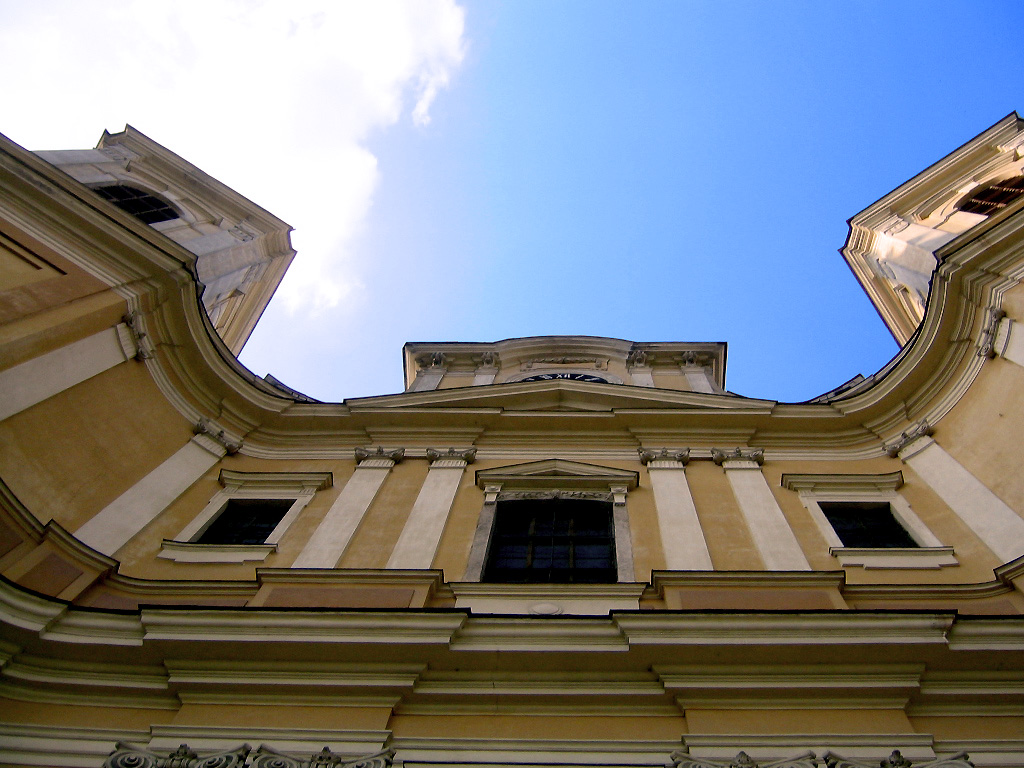
A Roman Catholic cathedral basilica dedicated to the Blessed Virgin Mary — a name shared by several historic cathedral churches in Latin America and Europe.
church
 Christianity
Cathedral of Ani
, Turkey
The eleventh-century Armenian Apostolic cathedral of the ruined Bagratid capital of Ani in eastern Turkey — the largest standing building of that lost medieval city.
church