
Islam
Süleymaniye Mosque
, Turkey
About
The Süleymaniye Mosque, Süleymaniye Camii, stands upon the Third Hill of Istanbul, commanding wide views of the Golden Horn. Commissioned by Sultan Suleiman the Magnificent, who reigned from 1520 to 1566, the mosque was designed by the imperial chief architect Mimar Sinan. An inscription fixes the foundation in 1550 and the inauguration in 1557, though work continued for several years thereafter.
The Süleymaniye is the largest Ottoman-era mosque in Istanbul and is regarded as one of the supreme achievements of Sinan's long career. Beneath a vast central dome flanked by half-domes, the prayer hall rises in serene proportion to its four slender minarets, and the use of light, sound and structural clarity makes the building a model of classical Ottoman sacred space.
Like other imperial Ottoman foundations, the mosque is the centre of a wider külliye, a charitable complex that originally included madrasas, a public soup kitchen, a hospital, a caravanserai, baths and shops, all sustained by endowed waqf properties.
Behind the qibla wall lies an enclosed cemetery containing the octagonal mausoleums of Suleiman the Magnificent and his wife Hurrem Sultan, known in the West as Roxelana, both adorned with İznik tiles. Sinan himself is buried in a modest tomb just outside the precinct walls. The mosque forms one component of the UNESCO World Heritage Site of the Historic Areas of Istanbul.
History
Suleiman the Magnificent first commissioned Sinan to build the Şehzade Mosque in memory of his son Crown Prince Mehmed and, impressed by the result, asked him to raise a mosque that would express the pre-eminence of the Ottoman Empire. Sinan responded with the Süleymaniye, conceived as the ceremonial culmination of his imperial commissions. After centuries of liturgical use the mosque survived earthquakes and the great fire of 1660, with successive restorations carried out through the Ottoman, late imperial and Republican eras to preserve its structural integrity.
Significance
The Süleymaniye Mosque represents the classical age of Ottoman religious architecture and the patronage of Suleiman the Magnificent, the longest-reigning sultan of the dynasty. As an active mosque of Friday prayer, a UNESCO World Heritage component and the resting place of the sultan and his architect, it remains a focal point of Islamic worship and of Ottoman cultural memory in Istanbul.
Visiting
Engage with Süleymaniye Mosque
Through the four pathways
Seva सेवा — Service
Offer your time and skills here. The following opportunities are open at Süleymaniye Mosque:
No Seva offerings listed yet.
Sādhana साधना — Practice
Learn the worship and practice associated with Süleymaniye Mosque:
No Sādhana offerings listed yet.
Sandhāna सन्धान — Wisdom
Unite with the wisdom of this tradition:
No Sandhāna offerings listed yet.
Sādhya साध्य — Giving
Support this sacred place according to your means:
No Sādhya offerings listed yet.
All giving flows directly to Süleymaniye Mosque. Mandala does not take a commission.
Related sacred places
 Islam
IslamAbu'l-Fida Mosque
, Syria
A medieval Sunni mosque and mausoleum complex on the banks of the Orontes River in Hama, Syria, where Ayyubid and Mamluk craftsmanship meet within a single walled sacred precinct.
mosque
_(14593689400).jpg%2F1280px-By_Nile_and_Tigris_-_a_narrative_of_Journeys_in_Egypt_and_Mesopotamia_on_behalf_of_the_British_Museum_between_the_years_1886_and_1913_(1920)_(14593689400).jpg&w=3840&q=75) Islam
IslamAl-Kadhimiya Mosque
, Iraq
One of the foremost Twelver Shia shrines, set in the Kāẓimiya district of Baghdad, Iraq, sheltering the tombs of the seventh and ninth Imams as well as great Shia scholars of the medieval era.
mosque
 Islam
IslamAl-Quds Mosque Hamburg
, Germany
A former Sunni Muslim mosque in the German port city of Hamburg, which served local worshippers from 1993 until its closure was ordered by German security authorities in 2010.
mosque
 Islam
IslamBasharat Mosque
, Spain
The principal Ahmadiyya mosque of Spain, built at Pedro Abad near Córdoba and inaugurated in 1982 as the centre of the Ahmadiyya community in the country.
mosque
.jpg%2F1280px-Bayezid_I_Mosque_-_Y%25C4%25B1ld%25C4%25B1r%25C4%25B1m_Camii_(1).jpg&w=3840&q=75) Islam
IslamBayezid I Mosque
, Turkey
An early Ottoman congregational mosque in Bursa, Turkey, raised between 1391 and 1395 as the centrepiece of the great külliye complex of Sultan Bayezid I, called 'Yıldırım' — the Thunderbolt.
mosque
 Islam
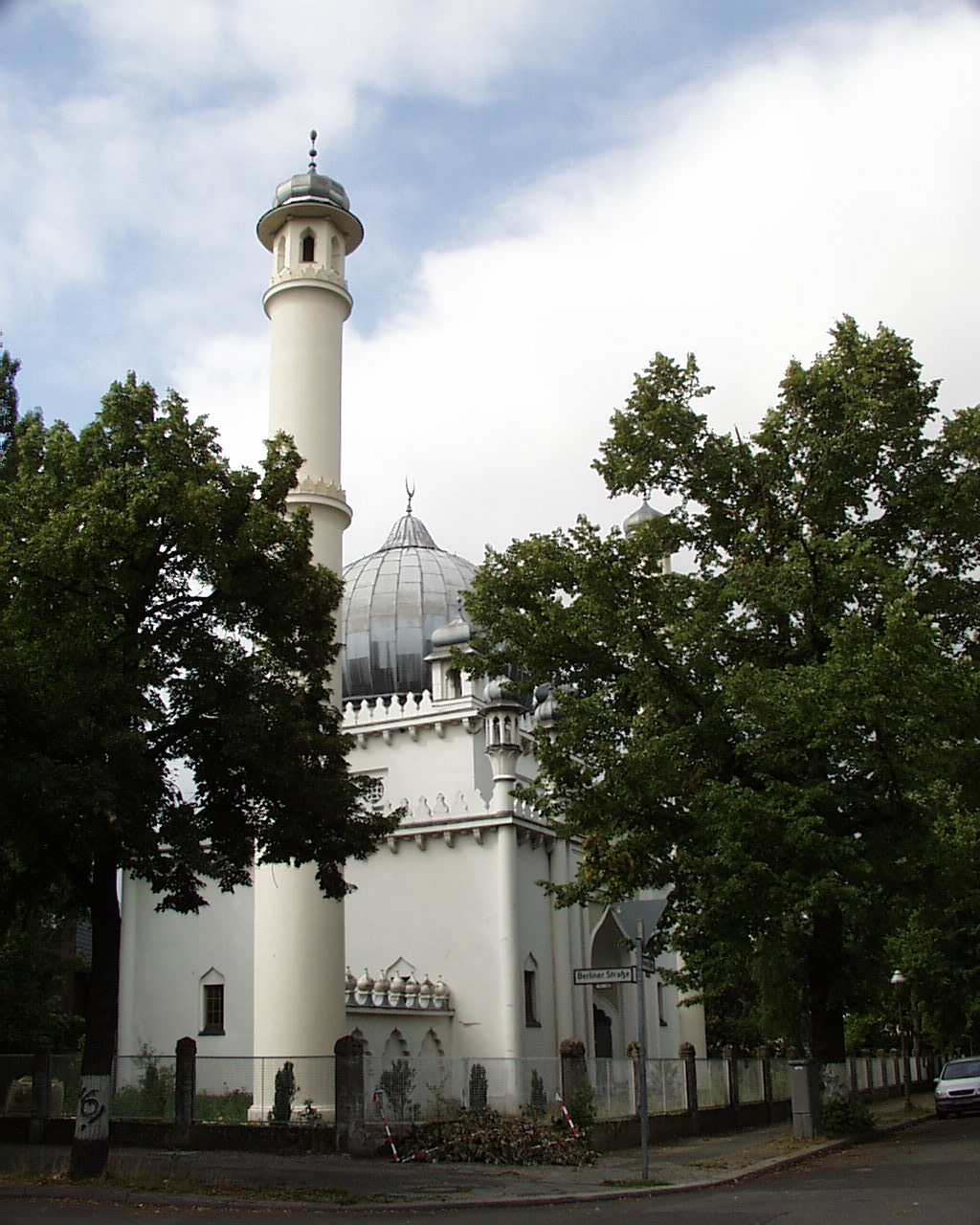
IslamBerlin Mosque
, Germany
The oldest surviving mosque in Germany, built in Berlin's Wilmersdorf district in the 1920s in a Neo-Mughal style and administered by the Lahore Ahmadiyya Movement.
mosque