_(14785829263).jpg%2F1280px-The_American_annual_of_photography_(1912)_(14785829263).jpg&w=3840&q=75)
Dr. G.W. Allyn (1845-1921) (Internet Archive Book Images) · Public domain
Christianity
York Minster
, United Kingdom
About
York Minster — formally the Cathedral and Metropolitan Church of Saint Peter in York — rises at the heart of the historic city in North Yorkshire. It is the cathedra of the Archbishop of York and serves as mother church to both the diocese and the province of York.
The site's Christian history reaches back to 627, when the first church was raised — a wooden chapel built in haste to baptise Edwin, King of Northumbria. The honorific 'minster' is of Anglo-Saxon date, originally describing a missionary teaching church. The surviving undercroft preserves reused fabric of around 1160, but the bulk of the present building was raised between 1220 and 1472 in successive Gothic campaigns: Early English transepts, a Decorated Gothic nave and chapter house, and a Perpendicular eastern arm and central tower.
The minster is celebrated above all for its medieval glass. The Great East Window, with its image of the Last Judgement, is the largest expanse of medieval stained glass anywhere in the world. The north transept contains the Five Sisters window, five lancets each over fifty-three feet high, filled with grisaille glass.
Its medieval construction followed a Norman cathedral begun in 1080. The English Reformation saw the loss of much treasure; in the Civil War, Thomas Fairfax preserved the building when York fell in 1644. Later centuries brought fires and arson — including Jonathan Martin's attack in 1829 — followed by painstaking restoration.
History
A bishop of York was summoned to the Council of Arles as early as 314, evidence of a Christian community in Roman York. The first recorded church on or near the site, however, was the wooden chapel raised in 627 to baptise King Edwin of Northumbria. A stone church begun by Edwin was completed in 637 by Oswald and dedicated to Saint Peter. Saint Wilfrid renewed the structure on becoming archbishop in 670, and Alcuin later described its splendour.
A Norman cathedral was begun in 1080 under Archbishop Thomas of Bayeux following Norman damage to the earlier building. The present Gothic minster rose between 1220 and 1472, beginning under Archbishop Walter de Gray. The central tower collapsed in 1407 and was rebuilt; the western towers were completed by 1472, when the cathedral was declared complete and consecrated. The cathedral has weathered the Reformation, the English Civil War, an arson attack in 1829, and an accidental fire in 1840, each followed by careful restoration.
Significance
York Minster has served continuously as the chief church of the Province of York for over a millennium, and its dean and chapter remain at the heart of Anglican worship in the north of England. The minster's stained glass — particularly the Great East Window and the Five Sisters — preserves an irreplaceable witness to medieval English religious art.
Visiting
Engage with York Minster
Through the four pathways
Seva सेवा — Service
Offer your time and skills here. The following opportunities are open at York Minster:
No Seva offerings listed yet.
Sādhana साधना — Practice
Learn the worship and practice associated with York Minster:
No Sādhana offerings listed yet.
Sandhāna सन्धान — Wisdom
Unite with the wisdom of this tradition:
No Sandhāna offerings listed yet.
Sādhya साध्य — Giving
Support this sacred place according to your means:
No Sādhya offerings listed yet.
All giving flows directly to York Minster. Mandala does not take a commission.
Related sacred places
 Christianity
Albenga Cathedral
, Italy
A medieval Roman Catholic cathedral in Liguria, Italy, dedicated to Saint Michael the Archangel and serving as seat of the Diocese of Albenga-Imperia.
church
 Christianity
Alexander Nevsky Cathedral
, Bulgaria
The Bulgarian Orthodox cathedral of Saint Alexander Nevsky in Sofia, a vast neo-Byzantine landmark and one of the largest Eastern Orthodox church buildings in the world.
church
 Christianity
Altamura Cathedral
, Italy
A thirteenth-century Roman Catholic cathedral in Apulia, southern Italy, dedicated to the Assumption of the Blessed Virgin Mary and a Hohenstaufen 'palatine' church.
church
_(5964742991).jpg%2F1280px-An_Auxiliary_Building_at_Bolnisi_Sioni_(I)_(5964742991).jpg&w=3840&q=75) Christianity
ChristianityBolnisi Sioni
, Georgia
A late-fifth-century Georgian Orthodox basilica in Bolnisi — the oldest surviving church building in Georgia, famed for its early Georgian-script inscriptions.
church
 Christianity
Cathedral Basilica of St. Mary
, Romania
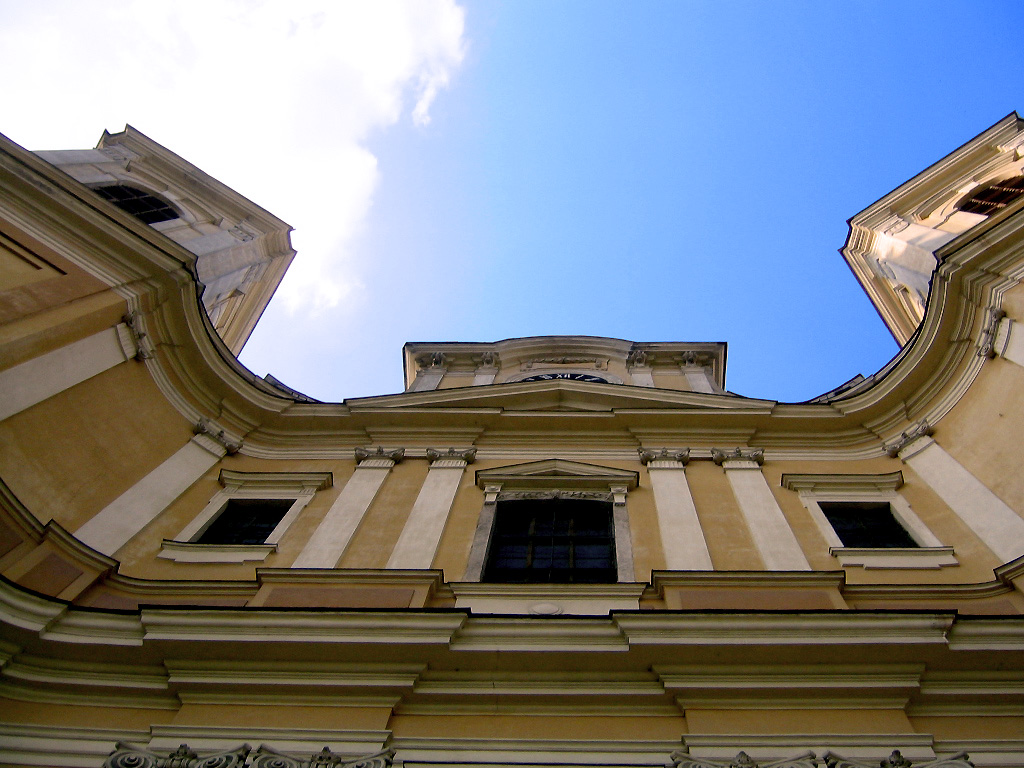
A Roman Catholic cathedral basilica dedicated to the Blessed Virgin Mary — a name shared by several historic cathedral churches in Latin America and Europe.
church
 Christianity
Cathedral of Ani
, Turkey
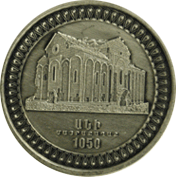
The eleventh-century Armenian Apostolic cathedral of the ruined Bagratid capital of Ani in eastern Turkey — the largest standing building of that lost medieval city.
church